Posted on January 15, 2012 in Breast lift (Mastopexy), Breast reduction, Hypertrophic scar, Keloid, Scar by Steven Turkeltaub
When it comes to breast reduction surgery, I find that women contemplating this procedure don’t usually place the appearance of the final scar at the top of their list of concerns. This is quite the opposite for those considering a mastopexy (breast lift) where this is a major area of concern.
Why is this the case despite the fact that the incisions, usually anchor shaped, are often identical?
The reason is that women who are seeking breast reduction surgery are doing so because of the annoying and even debilitating effects that their massively enlarged breasts are having on them and their quality of life. Women seeking a mastopexy are doing so largely for aesthetic reasons.
Does this mean that the appearance of the scars is relatively unimportant?
Of course not!
I am just as diligent and meticulous in the repair of breast reduction incisions as I am with the mastopexy ones (as well as for all incisions for all procedures). These are closed using long acting deep sutures in a multilayered repair that avoids the unnecessary and displeasing rail-road track suture marks in the skin. Skin tapes are applied for additional wound support and security and may be used for a total of two to three weeks. At that point in time, my patients will usually begin applying a topical silicone gel to help the scars heal as ideally and inconspicuously as possible. This is usually continued for several months. For patients at higher risk for developing hypertrophic scars or keloids or showing early evidence of their manifestation, silicone gel sheets are used to aggressively deal with these issues.
Most breast reduction scars heal very well, usually as fine lines, and are quite acceptable. It is rare in my experience to see keloids develop in darker complected women.

Before breast reduction

After breast reduction

Before breast reduction

After breast reduction
If you would like more information on a breast reduction surgery or on any other plastic surgery procedure that I perform or to schedule a consultation with me, please call my office at 480-451-3000.
Steven H. Turkeltaub, M.D. P.C.
Scottsdale and Phoenix, Arizona
More:
Posted on December 12, 2011 in Gynecomastia treatment, Male breast reduction, Scar by Steven Turkeltaub
Male breast reduction surgery for gynecomastia (enlarged male breasts) is one of the more commonly performed procedures in men. The results from surgery can be quite dramatic and rewarding. Despite the perception that men don’t obsess or even focus on their appearance a whole lot, this is not entirely or always true. Many men do care and when it comes to the appearance of their breasts.
The underlying cause of gynecomastia can be the result of enlarged glandular breast tissue, increased fat accumulation or a combination of both. Liposuction is the treatment of choice when there is an excessive amount of fat. It typically involves one relatively small incision (around 1/4” to 3/8”) for each side either along the breast fold or at the bottom part of the areola. They usually heal in an inconspicuous manner.
Glandular breast tissue can’t be removed with liposuction – it needs to be excised directly which is accomplished though an incision placed along the lower half of the areola. By nature, this incision is much longer as compared to the one needed for liposuction alone.
A question that many men have, particularly those that are younger and not hirsute (hairy) is “how obvious or apparent will the scars be?”
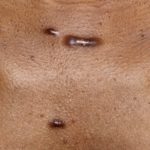
When the incisions are meticulously repaired (like they always should be!) and treated with a scar gel postoperatively, the final results are usually fairly thin white lines that are not apparent from any significant distance. Sometimes, they are so inconspicuous to the point of being imperceptible (see photo). Regardless, the overwhelmingly positive results from gynecomastia surgery virtually always outweigh any scar that is a consequence of the procedure.

Scar along the bottom half of the right areola
So, if you or someone you know is considering breast reduction surgery for gynecomastia but concerns about the scars have been a major issue, reconsideration should be in order.
If you would like more information on male breast reduction surgery for gynecomastia or on any other plastic surgery procedure that I perform or to schedule a consultation with me, please call my office at 480-451-3000.
Steven H. Turkeltaub, M.D. P.C.
Scottsdale and Phoenix, Arizona
More:
Posted on November 26, 2011 in Hypertrophic scar, Keloid, Scar, Scar revision by Steven Turkeltaub
Scars are the result of an injury to the skin, either traumatic in nature such as one caused by an accident or elective like one that is a consequence of surgery. Usually they heal level or nearly level with the surrounding skin though they can be wide. When they heal in a considerably elevated fashion within the area of the injury and are associated with firmness and redness, they are called hypertrophic scars. These types of scars usually develop soon after the injury and may regress over time, sometimes a year or more. Often, they are associated with pain and burning. Though they are frequently confused with keloids, the distinguishing factors are that keloids usually appear months to even years after the injury and extend considerably outside the original scar.

Hypertrophic scar of the right thigh
Some of the common treatments for hypertrophic scars include surgical excision, steroid injections, topical silicone sheets and cryotherapy (cold therapy). A variety of lasers have been also been used in attempts to treat these scars. Because lasers are high tech and have been touted for a multitude of other things, many patients request to have their hypertrophic scars treated using a laser.
Can lasers be employed to effectively and predictably treat hypertrophic scars or is their usage just hype and marketing?
A review of the literature on the usage of lasers in the treatment of hypertrophic scars was conducted and published in the November 2011 issue of The British Journal of Dermatology. It analyzed the data only from non-biased and properly controlled previously published clinical trials that employed a variety of lasers. This amounted to thirteen articles reporting on seven different laser types.
They found that only one of the seven laser types showed any evidence of possible therapeutic benefits. This was a pulsed dye laser (PDL) at the 595 nanometer wave length. In their conclusion, they stated that there was insufficient evidence at present to be able to recommend any laser as an effective treatment for hypertrophic scars though future studies may cause this approach to change.
So there is your answer!
If you would like more information on the treatment of hypertrophic scars, keloids or on any other plastic surgery procedure that I perform or to schedule a consultation with me, please call my office at 480-451-3000.
Steven H. Turkeltaub, M.D. P.C.
Scottsdale and Phoenix, Arizona
More:
Posted on July 19, 2010 in Scar, Scar revision by Steven Turkeltaub
Any “injury” to the skin that goes deep enough will produce a scar. This may be the result of trauma such as a laceration or very deep abrasion, burns or even elective as a necessary consequence of surgery. It is usually only when these are very perceptible that people will call them scars and contemplate addressing their appearance.
Scar revision is the generic term for the surgical approach that is aimed at improving the appearance of these scars and possibly also removing their untoward functional effects. The procedure can improve aesthetics and function but despite the misconception held by many, it will not make the scars disappear in their entirety. Once a scar, always a scar.
Scars can be wide, depressed, elevated, dark, and painful and even affect function such as causing a contracture at a joint. In its most common form, a scar revision would then entail the total or partial excision of the affected area and precise closure of the created defect possibly along with some ancillary techniques. Depending on the multiple factors such as size, location, complexity, health status and age, the procedure may be performed using a local anesthetic, sedation or even general anesthesia.
I see and treat a tremendous number of patients in my practice who present with a wide spectrum of undesirable scars. These include run of the mill wide or elevated scars, thick and symptomatic hypertrophic scars, keloids and burn scars. The improvements in appearance following scar revision can be quite dramatic and satisfying.
If you have any questions regarding scar revision, treatment of burn scars or keloids or any other plastic surgery procedure that I perform or if you would like to schedule a consultation with me, please call my office at 480-451-3000.
Steven H. Turkeltaub, M.D. P.C.
Scottsdale and Phoenix, Arizona
More:
Posted on July 12, 2010 in Breast lift (Mastopexy), Perioarolar mastopexy, Scar by Steven Turkeltaub
My philosophy for breast lift surgery is that it is better to use more or longer incisions if the final outcome will be far superior in contour and general aesthetics than that obtained by gimmicky usage of limited incisions. This has been reviewed in two previous posts (Periareolar Mastopexy: Sacrificing Shape and More for Less Incisions and The Lollipop Mastopexy: Shorter Incisions and Lesser Results)
The goal for a mastopexy should be to sculpture a natural appearing breast with a conical shape where the nipple-areola complex is situated at the most projecting portion of the breast. Significant deviations from this detract from the result and can lead to understandable dissatisfaction with the outcome. The technique that provides the most flexibility and precision for contouring and rejuvenating the breast three dimensionally as well as appropriately positioning the nipple-areola complex is the anchor shaped approach.
With the periareolar technique(also known as circumareolar, donut or purse string mastopexy), the lift, contouring, removal of excess skin and repositioning of the nipple-areola complex are all performed by essentially creating a donut shaped defect and purse stringing it closed. Clearly, this doesn’t allow for nuanced three dimensional correction. Furthermore, it creates an abnormal flatness precisely where one isn’t desired – where the nipple-areola complex is located and where the most projecting part of the breast should be. Common sequelae of the donut mastopexy are also wide, dysaesthetic scars, abnormally shaped and flattened areola and the appearance of pleats emanating from the areola outwards.
A vivid illustration of these issues can be seen in the photos below of a 36 year old woman who sought my help in consultation for the correction of her suboptimal results. She had undergone a periareolar mastopexy with implants by another plastic surgeon and was extremely unhappy with the outcome. Particularly problematic for her were the prominent scars, irregularities of the areolas and the overall breast shape. Had an anchor shaped scar mastopexy been chosen and performed well, it is highly probable that the outcome would have been far superior.

The results of a periareolar mastopexy performed by another plastic surgeon. The scars around the surgically deformed areola are extremely prominent, wide and unacceptable. Note the pleating effect - lines in the skin radiating outwards from the areola.

The scars from the donut mastopexy are quite apparent from virtually all angles. The flattening effect created by the purse string technique is well delineated in the right breast in this view. Rather than having a perky, conical shaped breast the result here is an abnormal, flattened, underprojecting one.

Unattractive and unacceptable scars on left breast from the donut mastopexy

Associated donut mastopexy scars on right breast
If you have any questions regarding breast lifts with or without a breast augmentation or on any other plastic surgery procedure that I perform or if you would like to schedule a complimentary consultation with me, please call my office at 480-451-3000.
Steven H. Turkeltaub, M.D. P.C.
Scottsdale and Phoenix, Arizona
More:
Posted on June 14, 2010 in Breast augmentation, Scar by Steven Turkeltaub
My preference for the insertion of breast implants in breast augmentation surgery is usually through an incision along the fold at the bottom of the breast also known as the inframammary approach. There are many advantages for this technique some of which I have enumerated on the website. One that wasn’t specifically mentioned is that the final scars from surgery will always be covered by one’s clothes and that can be important for those at a higher risk for more conspicuous scars.
An extremely small percentage of women state that they don’t want any scars located on their breasts as they will serve as telltale signs of them having had breast enlargement surgery. Instead, they request the transaxillary (armpit) approach for breast implant insertion. If their scars do not heal satisfactorily, they may have more significant issues.
The following patient saw me in consultation having undergone a breast augmentation elsewhere using this transaxillary technique. Thick hypertrophic scars developed that were re-excised by her plastic surgeon only to have them recur. Now she is faced with exposed, prominent scars that are clearly visible when she wears sleeveless tops and bathing suits. Furthermore, she does experience discomfort at times when reaching due to pulling on the thick scar.

View of right armpit revealing keloid that resulted from transaxillary incision. It has already been revised once by her original plastic surgeon.
If, instead, these same thick scars were situated on her breasts, at least they would be covered by her clothes and would not be apparent to anyone else until she removed her clothes. Furthermore, she would not have any restrictions in the clothes that she wanted to wear including sleeveless tops and that can be quite important in Arizona summers with temperatures far exceeding 100 degrees Fahrenheit.
If you have any questions regarding breast augmentations or incision choices, breast revision surgery or on any other plastic surgery procedure that I perform or if you would like to schedule a complimentary consultation with me, please call my office at 480-451-3000.
Steven H. Turkeltaub, M.D. P.C.
Scottsdale and Phoenix, Arizona
More:
Posted on May 3, 2010 in Earlobe, Keloid, Scar by Steven Turkeltaub
In my practice at the Arizona Center for Aesthetic Plastic Surgery, I see and treat a lot of patients who have keloids. Many people have the misconception that if a scar is wide, dark or large it must be a keloid which is not necessarily the case. A keloid is specifically an elevated and firm scar that extends beyond the margins of the initial wound or surgery site, does not regress spontaneously and can be difficult to treat. It is often aesthetically displeasing in appearance and frequently is associated with symptoms such as pain, burning or itching.

Keloid of the ear
There are several risk factors that predispose a person to develop keloids though their formation is not “inevitable”. Many high risk individuals never develop them whereas some people without any discernable risk factors can form them. Among these factors are being dark complected, age less than 30 years, burns, ear and earlobe piercings and injuries or surgery to the sternum and to a much lesser extent, the shoulders and upper arms. Certain orientations of these wounds also elevate the risk.

Keloid of the upper arm

Keloid of the shoulder
There are several treatment options available but effectiveness is increased with a lower incidence of recurrence when these are combined. The most commonly employed approaches include pressure dressings, steroid injections, topical silicone gel sheeting and surgical excision. More rarely employed treatments include using a pulsed dye laser, radiation treatments and intralesional injections of chemotherapy agents. Treatment should be individualized for each patient and would be determined by several factors.
The overwhelmingly most common area affected by a keloid that I see is the earlobe with the sternum being a distant second. I have seen them in every race – Caucasian, Hispanic, Asian-American, African-American, Native American, etc. – and in both females and males. Unless the keloid is extremely small (which is rare), the approach that I usually recommend and which is highly effective is for both surgical excision and steroid injection at the same time with possible re-injection a month later. Patients are then followed up on a monthly basis for any evidence of recurrence which can occur even up to several years later. At the first sign of possible regrowth, I will aggressively re-inject with the steroid medication.
If you have any questions on the treatment of keloids of the earlobes or any other area, on scars in general, or on any other plastic surgery procedure that I perform or if you would like to schedule a complimentary consultation with me, please call my office at 480-451-3000.
Steven H. Turkeltaub, M.D. P.C.
Scottsdale and Phoenix, Arizona
More: