
Time is a curious thing. Twenty-two years can feel like an eternity or like it passed in the blink of an eye, depending on where you are in life. For someone in their twenties, twenty-two years sounds almost unimaginable—a future filled with unknowns and decades of change. For someone in their forties, fifties or older, it feels much closer, a reminder that time moves faster with each passing year.
I can surely confirm this!
So much evolves over more than two decades. Careers shift, families grow, priorities change and bodies respond to life’s demands, habits and lifestyle. Gravity does not take breaks. Neither do the persistent stresses of living in today’s world. Hormones fluctuate. Weight changes. Skin loses elasticity. All of these things shape how our bodies look over time.
And yet, sometimes, somethings can remain remarkably consistent without dramatic changes.
In plastic surgery, a question that is frequently asked is: “How long will my breast augmentation last?”
The honest answer to this is that there is no single outcome. Instead, there is a broad spectrum of results depending on various factors including expectations and preferences.
Everyone is different. Each person’s life and individual factors are unique and varied. Some patients experience significant changes and require revision surgery. Others see gradual aging that mirrors what would have happened naturally. And occasionally, a patient’s long-term results are so well preserved that they seem almost frozen in time.
This blog highlights one such case—a patient who underwent a breast augmentation more than 22 years ago. She was in her early forties at the time of her procedure and recently returned for a consultation. The comparison between her early preoperative images and her results at 10 and 22 years later offers a fascinating look into what is possible with proper surgical planning, good tissue quality, favorable genetics and a reasonably healthy lifestyle.
The Original Surgery
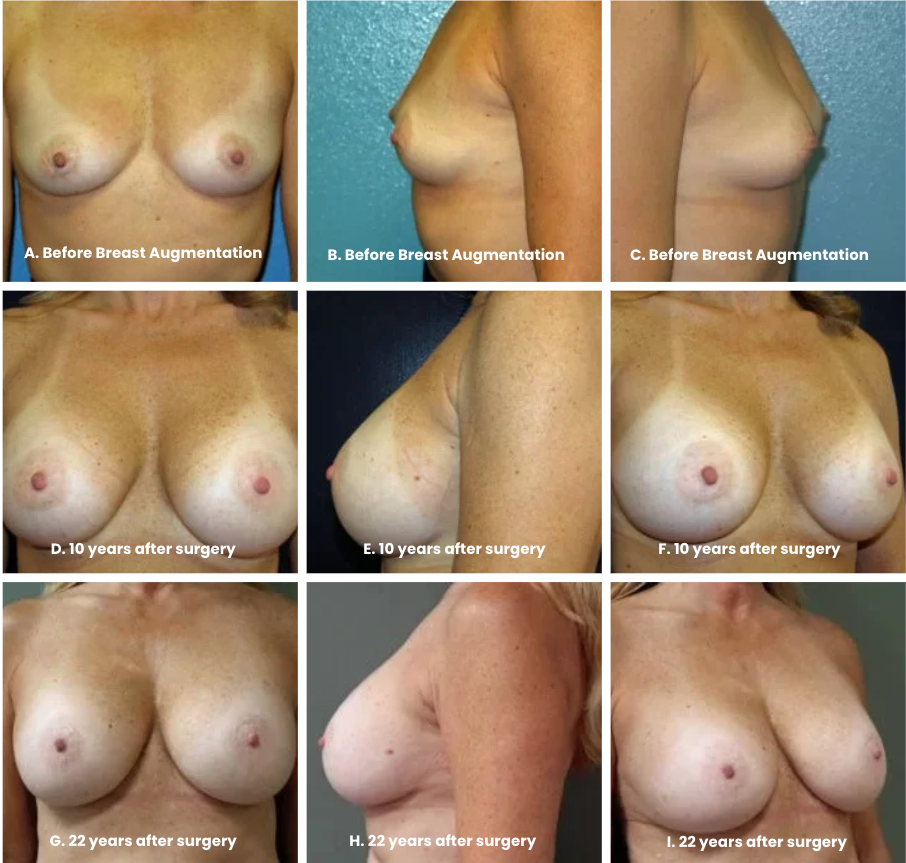
This patient underwent breast augmentation 22 years ago with the goal of restoring volume and improving shape while maintaining a natural appearance. She did not want a dramatic or “overdone” look. Instead, her priority was proportionality—breasts that suited her body frame and lifestyle. (Photos before surgery – A, B and C)
At the time of surgery, she received:
- Smooth-surfaced saline implants
- Submuscular placement (behind the chest muscle)
- An inframammary incision (hidden in the breast fold)
Her postoperative course was unremarkable and she was very happy with the results.
The Appearance at Ten Years
At 10 years following her breast augmentation, she was still quite happy with her results and was not experiencing any problems. (Photos D, E and F)
The Appearance at Twenty-Two Years
When seen more than twenty-two years later – in her mid-sixties – she was still very happy with her breast size and the proportionality with the rest of her body. Furthermore, she was not experiencing any issues relating to her implants. (Photos G, H and I)
Remarkably, at nearly a quarter of a century after her breast augmentation, her breasts did not deteriorate dramatically:
- The overall size remained consistent.
- The shape maintained some youthfulness.
- The skin envelope, though showing signs of stretching, had held up reasonably well.
- There was mild sagging.
- The implants remained well-positioned.
The differences between the 10-year and 22-year postoperative images are noticeable but not severe. This is even more impressive given the fact that these were saline breast implants and not silicone breast implants which are superior in many ways.
It is important to emphasize that this outcome is not exactly typical, but it is absolutely possible.
Why Do Some Results Age Better Than Others?
Breast augmentation results do not exist in isolation. They are influenced by a wide range of factors, most of which are outside the plastic surgeon’s control. Of course, if the initial results from surgery were less than ideal, all the other factors experienced over time are not very relevant.
Over more than 22 years, a woman’s body experiences countless physiological effects due to numerous factors. How the breasts respond depends on a combination of:
- Genetics
Some people simply have stronger skin elasticity and connective tissue. These patients tend to resist sagging longer and maintain structural support more effectively. - Weight Stability
Large fluctuations in weight can dramatically alter breast appearance. Gaining weight increases breast volume, often stretching the skin. Losing weight afterward can leave the breasts deflated and sagging. Patients who maintain a relatively stable weight tend to preserve their augmentation results far better. - Pregnancy and Breastfeeding
Pregnancy changes breast tissue through hormonal stimulation and enlargement. Breastfeeding adds additional stretching and volume shifts. These natural processes can significantly alter breast shape, even in women without implants. - Smoking History
Smoking negatively impacts skin quality and circulation, accelerating tissue aging and reducing elasticity. Nonsmokers generally maintain better long-term results. - Implant Placement
Submuscular placement provides structural support that can slow the appearance of drooping over time. - Implant Size Selection
Choosing implants that match the patient’s tissue capacity reduces excessive skin stretching and preserves breast integrity. - Lifestyle and Physical Activity
High-impact exercise, major changes in muscle mass, and significant fluctuations in body composition can all influence breast appearance. - Natural Aging
No surgical result is immune to gravity and time. The goal is not to stop aging but to age gracefully. - Sun Exposure and Tanning Booths
Both of these cause ultraviolet damage to the tissues resulting in premature aging of the skin, sun damage skin changes and loss of tissue elasticity.
This patient benefited from a favorable combination of many of these factors. She maintained a relatively stable weight over the years, did not smoke, lived an active but balanced lifestyle and had good genetics. In addition, the original surgical planning was conservative and anatomically appropriate.
Are Implants Meant to Last Forever?
Another common misconception is that breast implants must always be replaced after a fixed number of years – typically around ten years. While it is true that implants are not considered “lifetime devices,” there is no universal expiration date. Some patients require revision surgery at 10 or 15 years, while others, like this patient, go well beyond 20 years without problems.
Reasons for Breast Revision Surgery
Common reasons for breast revision surgery include:
- Implant rupture or deflation
- Capsular contracture (scar tissue tightening)
- Aesthetic changes due to aging or weight fluctuations
- Desire for size or implant type change
- Breast sagging requiring a lift
- No longer wanting or needing the breast implants
In this patient’s case, none of these were issues so there was no need for surgical intervention. Her implants remained functional and her aesthetic outcome was still excellent.
Setting Realistic Expectations
While this patient’s results are inspiring, they should not be seen as the standard expectation. Most women will experience some degree of breast change over 20 to 25 years after augmentation. Sagging of variable degrees, implant rupture or deflation, breast size issues and changes in aesthetic tastes are relatively common and normal.
The realistic goal of breast augmentation is not permanence without change but longevity with graceful aging.
Final Thoughts
Seeing breast augmentation results more than 22 years after surgery offers a powerful perspective. It reminds us that excellent long-term outcomes are possible, though not guaranteed. It highlights the importance of thoughtful surgical planning, appropriate implant selection and respect for the body’s natural structure. Of course, there are factors that are not alterable – like genetics.
This patient’s outcome is not entirely typical but it is real. It stands as an example of what can happen when the right conditions come together—good anatomy, sound surgical judgment and skill, responsible lifestyle choices and a bit of good fortune.
If you are interested in pursuing your breast augmentation, you can schedule a complimentary consultation with me, Dr. Steven Turkeltaub, either by calling the Arizona Center for Aesthetic Plastic Surgery at (480) 451-3000 or by contacting us online.
Steven H. Turkeltaub, M.D. P.C.
Scottsdale and Phoenix, Arizona