Posted on March 1, 2010 in Breast augmentation, Breast implants, Breast lift (Mastopexy), Breast reconstruction, Saline implants, Silicone implants
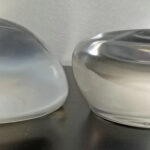
Breast implant exchange surgery is the replacing of one or both of one’s implants for a newer one or pair after previously having had a breast augmentation, mastopexy with implants or breast reconstruction. Why would a woman elect to undergo such a procedure? There are many reasons for this with some of the more common ones being:
- size change – usually to increase the implant volume and therefore the breast size; rarely to decrease
- to modify the breast configuration such as to make them more projecting or less wide
- to switch from saline to silicone implants; rarely, silicone to saline
- replace a ruptured breast implant
- in the course of treating one of a variety of aesthetic breast issues such as drooping or capsular contracture, replacing older implants with newer ones.
The most common reason for implant exchange is that a woman is unhappy with the selected size and wants to be significantly larger. It is fairly infrequent to desire a smaller size and this is often due either to the surgeon placing a far too large implant initially or the patient gaining a considerable amount of weight resulting in a marked enlargement of breast tissue.
In my practice, it is fairly rare for my patients to desire a change their breast implant size and if they do, it is usually years later. Why can I keep this rate extremely low? When evaluating my patients in consultation, I listen carefully to exactly what they want or think they want. I also measure and size them in the office, have them try on a variety of implants, and show them photos of other patients to provide them with a greater understanding and visualization. During surgery, this is fine tuned, as I will employ temporary implants in order to assess the effects of various sizes and configurations.
By offering many different styles of breast implants, I can customize the appearance that would be most appropriate and desirable for my patients. For example, patients who are very narrow and desire significant projection would be best served with higher profile implants whereas women who are broad with a moderate amount of breast tissue present may benefit more from moderate profile implants. Many of the patients that I perform implant exchanges on were done elsewhere and indicated that they were never offered or explained the options.
It is essentially unanimous that women prefer the silicone implants over the saline ones as they feel similar to breast tissue. When switching between fill materials, virtually all go from saline to silicone whereas the opposite is almost never performed due to aesthetic issues.
If you would like more information on silicone or saline breast implants, breast augmentation, breast lifts or any other plastic surgery procedure that I perform or to schedule a consultation with me, you can call my office at 480-451-3000.
Steven H. Turkeltaub, M.D. P.C.
Scottsdale and Phoenix, Arizona
More:
Print This Post
Posted on February 1, 2010 in Breast augmentation, Breast implants, Breast lift (Mastopexy), Breast reconstruction, Saline implants, Silicone implants
During the moratorium imposed by the U.S. Food and Drug Administration between 1992 and November 2006 that limited specific uses of silicone breast implants, women who wanted to have a breast augmentation could only be offered saline breast implants. Since the end of 2006, silicone breast implants have once again been available without restriction for all women desiring breast surgery. This includes for breast augmentation as well as breast lifts (mastopexy) with implants, breast reconstruction and those who want or need to exchange their implants for different ones.
Having been in plastic surgery practice for over 22 years in Scottsdale and Phoenix, Arizona, I have long been involved and dealt with and witnessed the multitude of factors and issues regarding silicone and saline breast implants. Prior to 1992, my patients used silicone implants exclusively and were quite happy. During the period of the moratorium in which all my breast augmentation patients and some of my mastopexy and breast reconstruction patients utilized saline implants, I noted that the aesthetic results and level of satisfaction with the naturalness of outcome were decreased and compromised compared to results with silicone implants.
This sentiment came as no surprise. Why? Silicone breast implants feel very natural and “soft”, like breast tissue, so that when they are in place, it often is very difficult to discern their presence particularly for the non-professional. Saline implants, on the other hand, can often be detected, either by sight, feel or both. This is exacerbated in very thin patients who often have “rippling” seen through their skin. These issues and others such as deflations do detract from their popularity. In patients of mine who have had both types of breast implants, every single one of them preferred and were far more satisfied with the silicone ones.
In the more than 3 year period since the lifting of the moratorium on the usage of silicone breast implants, virtually none of my patients select saline implants for their breast surgery which translates to around 99% silicone usage. For the rare few who do, it is only because of the lower cost of the saline implants.
If you are interested in obtaining additional information on silicone or saline breast implants, breast augmentation, mastopexy or any other plastic surgery procedure that I perform or to schedule a consultation with me, you can contact my office at 480-451-3000.
Steven H. Turkeltaub, M.D. P.C.
Scottsdale and Phoenix, Arizona
More:
Print This Post
Posted on January 18, 2010 in AlloDerm(R), Breast cancer, Breast reconstruction, Tissue expanders
Advances in breast reconstruction techniques for the correction of deformities resultant from treatment for breast cancer have shown great potential and results. This specifically relates to the usage of acellular dermis which is specially treated human tissue devoid of cells, infective agents and immunogenic potential (can’t be rejected by one’s body). Used for several years now, it has established a great track record in this usage.
Several biomedical companies offer this tissue though there are clearly differences in the products, results and risks. AlloDerm® by LifeCell Corp. has been the most studied of these with the results being superior.
In the December issue of Plastic and Reconstructive Surgery (Vol. 124 Number 6), a study from the University of Rochester delineated several advantages of acellular dermis in breast reconstruction. For immediate breast reconstruction using tissue expanders, they noted that the expanders could be filled to far greater amounts when AlloDerm® was employed as compared to a different technique. Postoperative inflations were fewer and completed much sooner and allowed for the insertion of the final breast implant at an earlier date. This translated into an accelerated rate of reconstruction, more predictable and satisfactory results and the potential for a better aesthetic appearance. Best of all, there was no significant difference in complication rates with its usage.
I have been using AlloDerm® in my patients undergoing immediate as well as late breast reconstruction procedures and have found it to be an incredibly invaluable addition. It allows for clearly superior and more predictable results in configuration, positioning and softness and reduces the need for subsequent procedures to further refine the results.
If you would like to obtain additional information on breast reconstruction including the usage of tissue expanders or on any other plastic surgery procedure that I perform or if you want to schedule a consultation with me, you can contact my office at 480-451-3000.
Steven H. Turkeltaub, M.D. P.C.
Scottsdale and Phoenix, Arizona
More:
Print This Post
Posted on January 11, 2010 in Breast cancer, Breast reconstruction, Radiation treatment, Tissue expanders
In breast reconstruction, the ultimate goal is to recreate a breast that is as close as possible to the remaining breast. Perfect symmetry is naturally impossible. Even in situations where the reconstructed breast may be somewhat “similar” to the remaining breast in appearance in the immediate postoperative period, the two sides will invariably change or age differently over time, thereby increasing the differences.
Women who have undergone bilateral mastectomies inherently have better odds of obtaining symmetry in their breast reconstruction. Why? The reason is that they are often starting with similar deformities on each side, thereby allowing for the same reconstructive technique to be utilized for both breasts. This is true whether reconstruction is performed with the simple insertion of implants, usage of tissue expanders or with flaps such as a TRAM flap.
One notable caveat to this is if one side had been irradiated as an adjunct treatment of the breast cancer. As I noted in an earlier post (Problems With Tissue Expansion Breast Reconstruction In Previously Irradiated Tissue), the ionizing effects of the radiation treatments damages the skin resulting in scarring, thickening, increased rigidity and less suppleness of the tissues which often also show visual signs of the damage. This translates into tissue that is more resistant to the stretching that is necessary with tissue expansion breast reconstruction as well as breasts that often feel quite rigid or hard.
The following case illustrates this exact scenario. The patient underwent a bilateral mastectomy with radiation subsequently performed on the left side. In the photos, you may be able to appreciate the slightly darker color and firmness of the skin.

a.) Bilateral mastectomies with left breast irradiation. Pre-op

b.) Bilateral mastectomies with left breast irradiation. Post-op insertion and inflation of tissue expanders

c). Pre-op

d.) Post-op insertion and inflation of tissue expanders

e.) Pre-op

f.) Post-op insertion and inflation of tissue expanders
She elected to undergo bilateral breast reconstruction using tissue expanders. Despite using identical tissue expanders, there is a significant difference in appearance between the two sides. Ironically, though the irradiated left side is inflated with more saline than the right, it actually appears less voluminous. That is an effect of the radiation damage.
If you would like to obtain additional information on breast reconstruction, breast implants or any other plastic surgery procedure that I perform or to schedule a consultation, you can contact my office at 480-451-3000.
Steven H. Turkeltaub, M.D. P.C.
Scottsdale and Phoenix, Arizona
More:
Print This Post
Posted on October 26, 2009 in Breast augmentation, Breast implants, Breast lift (Mastopexy), Breast reconstruction, Nipple-areola complex
There are many advantages of placing breast implants behind the pectoralis major muscle for a breast augmentation, breast lift (mastopexy) and in breast reconstruction. The most significant of these include:
- Better ability to detect abnormalities on mammograms versus in front of the muscle (submammary)
- Lower risk for capsular contracture (hardness of the breast caused by the formation of scar tissue around the implants)
- More soft tissue coverage overlying the implant resulting in a lower risk and extent of visible rippling
- Provides a better and more natural interface of the implant with the chest wall
- Serves to provide better support of the implant long term as compared to above the muscle where the weight of the implant will cause greater stretching and thinning out of the skin over time as well as its descent on the chest wall

Implants above the muscle. Note the rippling, harsher contours, stretched areolas and unnaturalness of the result. (not my patient)

Implants behind the muscle. Note the more natural shape and smoother curves. This approach is recommended for most of my patients.
Except for some rare exceptions, most women are best served with the submuscular placement of their implants. As a result, this is my recommendation for virtually all of my patients.
If you would like additional information on a breast augmentation, breast lift, breast reconstruction or any cosmetic surgery procedure or to schedule a consultation, you can call my office at 480-451-3000.
Steven H. Turkeltaub, M.D. P.C.
Scottsdale and Phoenix, Arizona
More:
Print This Post
Posted on September 28, 2009 in Breast cancer, Breast reconstruction, Breast reduction
Prior to undergoing a breast reduction, it is the standard of care to have an up to date mammogram for women of at least a certain age (which can vary). The purpose of this is to screen for any abnormalities that may need to be addressed prior to surgery. If a suspicious mass or area is noted that raises concerns for possibly being of malignant potential, a biopsy can be performed prior to the planned procedure. If the results are benign, then one can proceed with the breast reduction. Conversely, if the biopsy results reveal breast cancer, then treatment of this would be to be undertaken rather than the originally proposed breast reduction.
Mammograms do not identify every single case of breast cancer. A small percentage of breast cancers that are early or very small can evade detection with this method of screening but can be identified pathologically. These “occult” cancers are the reason why the breast tissue removed in the performance of a breast reduction is always sent for pathological evaluation.
Scientific studies have been done to investigate the incidence of these occult cancers in women who have undergone a breast reduction. The percentage is very low, somewhere in the range of 0.16% to 0.40%. Despite having been diagnosed with breast cancer, these women are lucky in that their tumors were identified early on, offering them a very high cure rate with appropriate treatment. If they hadn’t been seeking a breast reduction, it is likely that many of these cancers might not have been identified until they were larger and with a less favorable prognosis.
The following patient of mine exemplifies this scenario. She presented for a breast reduction at age 39, wearing a size 34G bra, no family history of breast cancer and with a normal mammogram. A reduction mammoplasty was successfully performed and she had an otherwise unremarkable postoperative course. However, the pathology report of her removed breast tissue revealed early cancer.
After consulting with a general surgeon, she underwent bilateral mastectomies with immediate reconstruction. The following photos illustrate her preoperative appearance, immediately following her breast reduction and appearance after reconstruction.

Before Breast Reduction - Frontal view

Before Breast Reduction - Side view

Immediately following Breast Reduction - Frontal view

Immediately following Breast Reduction - Side view

After Breast Reconstruction - Frontal view in bra

After Breast Reconstruction - Frontal view

After Breast Reconstruction - Oblique view

After Breast Reconstruction - Oblique view in bra

Following Breast Reconstruction - Side view

Following Breast Reconstruction - Side view in bra
If you would like to obtain additional information on breast reduction, breast reconstruction or any other cosmetic surgery procedure that I perform or to schedule a consultation, you can contact my office at 480-451-3000.
Steven H. Turkeltaub, M.D. P.C.
Scottsdale and Phoenix, Arizona
More:
Print This Post
Posted on August 31, 2009 in Breast cancer, Breast reconstruction, Radiation treatment, Tissue expanders
Radiation treatment following a mastectomy in the treatment of breast cancer is fairly common. Though refinements have been made in the radiation therapy that have significantly reduced both short and long term sequelae to the skin and underlying tissues, permanent consequences nevertheless exist which will affect the tissue expander breast reconstruction.
What does radiation do to the skin and soft tissues? The ionizing effects damage healthy cells causing scarring and thickening with increased rigidity of the tissues and less suppleness. The result is firmer feeling skin that is more rigid and more resistant to the stretching which is necessary with tissue expansion breast reconstruction. The small blood vessels in the field of treatment are also permanently damaged resulting in a reduction of blood supply to the tissues. Less oxygen and nutrients available to the tissues translates into an increased the risk of infection, greater susceptibility to trauma and prolonged healing times from surgery and injury. .
As a consequence of these changes, it is far more difficult to expand irradiated tissue in facilitating the breast reconstruction as compared to normal tissue. The increase in size obtained may be less than ideally desired and it can take much longer. Qualitatively, it often feels firm and appears darker than the surrounding skin. There is also an increased incidence of infections, formation of scar tissue around the expander, separation of recently closed incisions and even extrusion and exposure of the tissue expander through the skin.
Though tissue expander breast reconstruction can yield satisfactory results in tissue that has been previously irradiated, there are many attendant risks that need to be considered before selecting this option.
If you would like to obtain additional information on breast reconstruction or any other surgical procedure that I perform or to schedule a consultation, you can contact my office at 480-451-3000.
Steven H. Turkeltaub, M.D. P.C.
Scottsdale and Phoenix, Arizona
More:
Print This Post