Posted on August 21, 2010 in AlloDerm(R), Breast implants, Breast reconstruction, Breast revision, Subcutaneous mastectomy
Breast revision is a commonly performed procedure that serves to address one or more issues in a woman who has previously undergone a cosmetic or reconstructive breast surgery. This can involve a prior breast augmentation, breast reduction, breast lift or even a breast reconstruction. Each individual has unique issues which have to be addressed accordingly in order to obtain more desirable results.
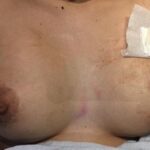
The following 62 year old patient underwent a prophylactic mastectomy with breast implant reconstruction 25 years ago (specifically called a subcutaneous mastectomy) due to a strong family history of breast cancer. This was followed by multiple procedures over the years in attempts to improve the outcome. She consulted with me because of the chronic and substantial pain that she was experiencing in both breasts, their extreme hardness as well as the significant and problematic deformities of appearance.

Prior to breast revision surgery - frontal view

Following breast revision surgery - frontal view

Before breast revision surgery - oblique view

Following breast revision surgery - oblique view

Before breast revision surgery - side view

After breast revision - side view

After breast revision surgery

Before surgery
In her photos you can appreciate the marked asymmetries of shape, contour and implant position with the right side being situated too high. The skin has extensive irregularities and folds and in areas is quite thin. Her nipples also are too low relative to the breast mounds creating far too much fullness higher up.
Her breast revision surgery consisted of meticulous removal of deforming scar tissue known as a capsulectomy, reshaping of the breasts and placement of AlloDerm® (a regenerative tissue matrix – dermal grafting material) in both sides for support, contouring, durability and increased tissue thickness. Appropriately configured and sized implants replaced those that were present.
The outcome of all this were significant improvements in the appearance of her breasts for which the patient was extremely happy and quite thankful. It also boosted her self-confidence tremendously.
If you have any questions regarding breast revision surgery, breast reconstruction or any other plastic surgery procedure that I perform or if you would like to schedule a complimentary consultation with me, please call my office at 480-451-3000.
Steven H. Turkeltaub, M.D. P.C.
Scottsdale and Phoenix, Arizona
More:
Print This Post
Posted on July 26, 2010 in Breast augmentation, Breast implants, Breast reduction
There is great news for women as well as men: women’s breasts have been getting noticeably and naturally larger over the past 50 years. This is an unmistakable finding which is unrelated to weight and height issues and is completely independent of breast implants.
Many theories have been advanced to explain this burgeoning of breast volume but there is no one definitive answer. Some feel that it is related to the improved general nutrition in experienced by women during this period of time including increased intake of fruits, vegetables and most importantly, proteins. Others ascribe this change to estrogen and other substances in our foods and environment including hormones injected into poultry and livestock and even from the BPA in plastic bottles. Birth control pills do facilitate an enlargement of the breasts but only in those who are taking them – so this doesn’t explain the global changes that have developed.
During this same period of time that the average size of women’s breasts has significantly enlarged, women have also increased the desired size that they ultimately want their breasts to be.
What are the results of all of this? More women than ever are desirous of a breast augmentation. Seemingly ironic, at the same time and as a result of other factors as well, more women than ever are undergoing breast reduction surgery. This may seem totally confusing and conflicting but it really does make sense. I have seen these trends in my practice over the last 23 years.
If you would like more information on breast augmentations, breast reductions or on any other plastic surgery procedure that I perform or to schedule a free cosmetic consultation with me, please call my office at 480-451-3000.
Steven H. Turkeltaub, M.D. P.C.
Scottsdale and Phoenix, Arizona
More:
Print This Post
Posted on June 7, 2010 in Breast augmentation, Breast implants, Breast lift (Mastopexy)
A breast lift, also known officially as a mastopexy, is the procedure that re-suspends, contours, tightens and rejuvenates the appearance of the droopy breast. Performed by itself without the addition of breast implants, the results are breasts that actually appear smaller than a person might have expected. So the question becomes when should a woman consider having breast implants inserted at the same time as the mastopexy?
Most of the time, the answer to this is fairly obvious. If you find that your droopy breasts are smaller than you ultimately want them to be, then undergoing a breast augmentation at the same time would provide you with the means to be larger. On the other, if you feel that your saggy breasts are already bigger than you ultimately want to be, then there is no need for breast implants and instead, a removal of breast tissue would be in order. (Note: When your breasts are extremely large in addition to being droopy, the appropriate procedure to correct this is a breast reduction – of which a lift is an inherent component.)
It is the middle ground, where you breasts appear to be somewhat in the size range that you would like them to be, that the need for breast implants is unclear. Because: a.) a mastopexy involves making the breast tighter, denser and smaller as well as the removal of a variable amount of tissue b.) most women would like more fullness at the upper pole (top part) of their breasts and c.) most women would rather be a little larger than smaller … I find that inserting even a relative small breast implant works wonders for the ultimate result.
It has been my experience in over twenty two years of plastic surgery practice that a vast majority of my patients undergoing a mastopexy also have a breast augmentation concurrently. The results are larger breasts with a fuller and more youthful shape and firmness as well as improved cleavage.
If you would like more information on a mastopexy, breast augmentation surgery, breast implants or on any other plastic surgery procedure that I perform or to schedule a free consultation with me, please call my office at 480-451-3000.
Steven H. Turkeltaub, M.D. P.C.
Scottsdale and Phoenix, Arizona
More:
Print This Post
Posted on April 19, 2010 in Breast augmentation, Breast implants
An overwhelming majority of women who have had a breast augmentation are very happy with their outcomes, physically and mentally. The overall impact on their appearance on many levels surely can’t be overstated. Just ask someone who has had it done – they will usually rave about it.
An interesting question that is rarely discussed is whether the positive physical results from the breast enlargement will be at least somewhat maintained over time. This can include weight fluctuations and even major net weight increases. The answer to this is unequivocally – Yes! However, pregnancies and breast feeding will have a more significant impact on the appearance specifically related to its effects on the elasticity of the skin and volume and density of the breast tissue which often can translate into drooping.
I have had long term follow ups on many women who had me perform their breast augmentation procedure ten to twenty or more years ago and virtually all have maintained their aesthetically pleasing improvements. This is despite the fact that many of them had gained 10 or more pounds and is also independent of their breast implant type, saline or silicone. One important caveat is that nearly all of my patients had their breast implants placed in a submuscular pocket, the location which I strongly believe provides better long term support. There would have been a much greater deterioration of the results if the breast implants had been situated in a submammary pocket (above the muscle).

Before breast augmentation - front view

Before breast augmentation - side view

4 months after breast augmentation - front view

4 months after breast augmentation - side view

8 years after breast augmentation and 40 pound weight gain - front view

8 years after breast augmentation and 40 pound weight gain - side view
If you would like to obtain additional information on breast augmentation surgery, a mastopexy or any other cosmetic procedure that I perform or to schedule a consultation, you can contact my office at 480-451-3000.
Steven H. Turkeltaub, M.D. P.C.
Scottsdale and Phoenix, Arizona
More:
Print This Post
Posted on April 5, 2010 in Breast augmentation, Breast implants, Saline implants, Silicone implants
I find it amazing that so many people who have had or who are contemplating breast augmentations are under the false impression that breast implants should be changed every ten years. Did their plastic surgeon impart that advice to them or did a friend who had it done misinterpret some information? Or, did they read it somewhere on the internet?
This is absolutely a “young” wives tale, an urban (suburban and rural) legend without any factual basis. There is no fixed period of time after a breast augmentation or mastopexy with implants at which point breast implants should be replaced. Some implants may last only 5 years or even less (rare) whereas others may remain intact for thirty years or more.
In general, I inform my patients who are considering breast enlargement surgery that breast implants, though quite durable, are not “permanent” devices that will never need to be exchanged or removed. Given enough time, probably all of them would eventually need to be replaced. It is my experience that the silicone implants do last considerably longer in comparison to saline implants. There are also differences in implant lifespan that are manufacturer dependent.
Let me repeat this again so that there can be no confusion:
There is no rule or evidence that breast implants need to be replaced every ten years.
If you want more information regarding breast implants, breast augmentation or any other plastic surgery procedure that I perform or if you would like to schedule a complimentary consultation with me, please contact my office at 480-451-3000.
Steven H. Turkeltaub, M.D. P.C.
Scottsdale and Phoenix, Arizona
More:
Print This Post
Posted on March 1, 2010 in Breast augmentation, Breast implants, Breast lift (Mastopexy), Breast reconstruction, Saline implants, Silicone implants
Breast implant exchange surgery is the replacing of one or both of one’s implants for a newer one or pair after previously having had a breast augmentation, mastopexy with implants or breast reconstruction. Why would a woman elect to undergo such a procedure? There are many reasons for this with some of the more common ones being:
- size change – usually to increase the implant volume and therefore the breast size; rarely to decrease
- to modify the breast configuration such as to make them more projecting or less wide
- to switch from saline to silicone implants; rarely, silicone to saline
- replace a ruptured breast implant
- in the course of treating one of a variety of aesthetic breast issues such as drooping or capsular contracture, replacing older implants with newer ones.
The most common reason for implant exchange is that a woman is unhappy with the selected size and wants to be significantly larger. It is fairly infrequent to desire a smaller size and this is often due either to the surgeon placing a far too large implant initially or the patient gaining a considerable amount of weight resulting in a marked enlargement of breast tissue.
In my practice, it is fairly rare for my patients to desire a change their breast implant size and if they do, it is usually years later. Why can I keep this rate extremely low? When evaluating my patients in consultation, I listen carefully to exactly what they want or think they want. I also measure and size them in the office, have them try on a variety of implants, and show them photos of other patients to provide them with a greater understanding and visualization. During surgery, this is fine tuned, as I will employ temporary implants in order to assess the effects of various sizes and configurations.
By offering many different styles of breast implants, I can customize the appearance that would be most appropriate and desirable for my patients. For example, patients who are very narrow and desire significant projection would be best served with higher profile implants whereas women who are broad with a moderate amount of breast tissue present may benefit more from moderate profile implants. Many of the patients that I perform implant exchanges on were done elsewhere and indicated that they were never offered or explained the options.
It is essentially unanimous that women prefer the silicone implants over the saline ones as they feel similar to breast tissue. When switching between fill materials, virtually all go from saline to silicone whereas the opposite is almost never performed due to aesthetic issues.
If you would like more information on silicone or saline breast implants, breast augmentation, breast lifts or any other plastic surgery procedure that I perform or to schedule a consultation with me, you can call my office at 480-451-3000.
Steven H. Turkeltaub, M.D. P.C.
Scottsdale and Phoenix, Arizona
More:
Print This Post
Posted on February 1, 2010 in Breast augmentation, Breast implants, Breast lift (Mastopexy), Breast reconstruction, Saline implants, Silicone implants
During the moratorium imposed by the U.S. Food and Drug Administration between 1992 and November 2006 that limited specific uses of silicone breast implants, women who wanted to have a breast augmentation could only be offered saline breast implants. Since the end of 2006, silicone breast implants have once again been available without restriction for all women desiring breast surgery. This includes for breast augmentation as well as breast lifts (mastopexy) with implants, breast reconstruction and those who want or need to exchange their implants for different ones.
Having been in plastic surgery practice for over 22 years in Scottsdale and Phoenix, Arizona, I have long been involved and dealt with and witnessed the multitude of factors and issues regarding silicone and saline breast implants. Prior to 1992, my patients used silicone implants exclusively and were quite happy. During the period of the moratorium in which all my breast augmentation patients and some of my mastopexy and breast reconstruction patients utilized saline implants, I noted that the aesthetic results and level of satisfaction with the naturalness of outcome were decreased and compromised compared to results with silicone implants.
This sentiment came as no surprise. Why? Silicone breast implants feel very natural and “soft”, like breast tissue, so that when they are in place, it often is very difficult to discern their presence particularly for the non-professional. Saline implants, on the other hand, can often be detected, either by sight, feel or both. This is exacerbated in very thin patients who often have “rippling” seen through their skin. These issues and others such as deflations do detract from their popularity. In patients of mine who have had both types of breast implants, every single one of them preferred and were far more satisfied with the silicone ones.
In the more than 3 year period since the lifting of the moratorium on the usage of silicone breast implants, virtually none of my patients select saline implants for their breast surgery which translates to around 99% silicone usage. For the rare few who do, it is only because of the lower cost of the saline implants.
If you are interested in obtaining additional information on silicone or saline breast implants, breast augmentation, mastopexy or any other plastic surgery procedure that I perform or to schedule a consultation with me, you can contact my office at 480-451-3000.
Steven H. Turkeltaub, M.D. P.C.
Scottsdale and Phoenix, Arizona
More:
Print This Post
Posted on January 4, 2010 in Breast augmentation, Breast implants, Saline implants, Silicone implants
Unlike with silicone implants used in breast augmentation, the diagnosis of a ruptured saline implant is usually quite easy and apparent. Most of the time there is a rapid and dramatic decrease in volume of the implant and, therefore, in the size of the affected breast. This can occur in a matter of a few hours to a few days though I have had a few patients who have noted a very gradual decrease in size over a period of even several months.
What happens to the saline? Your body will absorb the fluid which is harmless. As it does, your breast will further decrease in size.
Once it is apparent that the implant is ruptured, I recommend that the situation be addressed sooner than later. The reason for this is that the tissue which had been previously stretched out will contract around the deflated breast implant over time and form variable amounts of somewhat constrictive scar tissue. This can make it more difficult to reacquire the level of symmetry that had been present prior to the deflation.
The plastic surgery options available for treatment of a ruptured saline breast implant following a breast augmentation fall into four general categories:
1. Replace just the deflated implant.
2. Elect to undergo a bilateral implant exchange. With this approach, one can also change size, style and switch to silicone implants
3. Remove both breast implants (also known as bilateral explantation).
4. Do nothing at all. This option is almost never selected.
In your consultation, I would discuss each of the above options in detail including the pros and cons in order to allow you to make an informed decision.
If you would like additional information on breast implants, breast augmentation, mastopexy with breast enlargement or any other plastic surgery procedure or to schedule a consultation, you can call my office at 480-451-3000.
Steven H. Turkeltaub, M.D. P.C.
Scottsdale and Phoenix, Arizona
More:
Print This Post
Posted on December 14, 2009 in Breast augmentation, Breast implants, Symmastia
Breast augmentation is among the most common plastic surgery procedures that women chose and is associated with an extremely high satisfaction rate in the vicinity of 94%. Despite such an astounding level of happiness, there are many variables and issues that can lead to less than desirable results. One relatively uncommon problem is where the two breasts seem to coalesce into one larger unit which is scientifically called symmastia (also synmastia) or in lay terms, a uniboob. In this situation, the breast implants can move or be moved so far to the midline that they may actually touch each other.

What are the causes and who is at a greater risk of developing this deformity? In general, women who are fairly thin and those who have a chest wall deformity known as pectus excavatum (where the sternum has a caved in appearance) are at a higher risk. This is risk is further amplified by a desire to have their breasts situated close together and by the selection of disproportionately large implants.
Symmastia is usually the result of overzealous dissection of the implant pocket medially (near the midline). In attempting to decrease the distance between the breasts so as to facilitate more cleavage, a surgeon may over-release tissue that is normally adherent to the underlying sternum. This allows the implants to migrate so far to the midline that they may actually touch. The skin then redrapes over the breast implants rather than discretely attaching to the sternum which results in the amorphous shaped uniboob versus two well defined breasts. Symmastia occurs both with breast implants that have been placed in submammary and submuscular pockets.
A few treatment options are available to correct this deformity including a relatively new approach using specially processed tissue (Alloderm® and Strattice®). Repair of symmastia can be very challenging and the results not always ideal. Selecting smaller and less wide implants will also assist in obtaining a more predictable and permanent correction.
If you would like additional information on symmastia, breast augmentation, breast implants, mastopexy or any other plastic surgery procedure or to schedule a consultation, you can call my office at 480-451-3000.
Steven H. Turkeltaub, M.D. P.C.
Scottsdale and Phoenix, Arizona
More:
Print This Post
Posted on October 26, 2009 in Breast augmentation, Breast implants, Breast lift (Mastopexy), Breast reconstruction, Nipple-areola complex
There are many advantages of placing breast implants behind the pectoralis major muscle for a breast augmentation, breast lift (mastopexy) and in breast reconstruction. The most significant of these include:
- Better ability to detect abnormalities on mammograms versus in front of the muscle (submammary)
- Lower risk for capsular contracture (hardness of the breast caused by the formation of scar tissue around the implants)
- More soft tissue coverage overlying the implant resulting in a lower risk and extent of visible rippling
- Provides a better and more natural interface of the implant with the chest wall
- Serves to provide better support of the implant long term as compared to above the muscle where the weight of the implant will cause greater stretching and thinning out of the skin over time as well as its descent on the chest wall

Implants above the muscle. Note the rippling, harsher contours, stretched areolas and unnaturalness of the result. (not my patient)

Implants behind the muscle. Note the more natural shape and smoother curves. This approach is recommended for most of my patients.
Except for some rare exceptions, most women are best served with the submuscular placement of their implants. As a result, this is my recommendation for virtually all of my patients.
If you would like additional information on a breast augmentation, breast lift, breast reconstruction or any cosmetic surgery procedure or to schedule a consultation, you can call my office at 480-451-3000.
Steven H. Turkeltaub, M.D. P.C.
Scottsdale and Phoenix, Arizona
More:
Print This Post
Posted on August 10, 2009 in Breast augmentation, Breast implants
Girls in today’s world are exposed to more body image related issues and information than ever before. This includes from well informed (and endowed) peers, exposure to countless magazines displaying a profusion of voluptuous female bodies, countless sexually overt TV shows, and limitless information and images from the internet. With particular emphasis on breast size, those that are or feel deficient often know what they need to do. Get breast implants!
Dissatisfaction with one’s body image, including breast size, is the norm for the adolescent female. During this period of time, they are growing physically and experiencing myriad psychological and emotional issues and variability. This translates into a period of exceptional instability during which it would not be prudent to consider most cosmetic surgery procedures.
At what age, then, would a girl/woman be an appropriate candidate for a breast enlargement surgery? Though there is not be an exact right or wrong answer given the variability in emotional, physical and intellectual maturation between individuals, my personal recommendation is to wait until 18 years of age except in unusual circumstances. For many reasons, I feel this is best for all parties involved.
There are exceptions, of course. Girls who have breasts of markedly different sizes where the disparities are difficult to camouflage or who have extreme under-development or congenital absence on one side would be candidates for surgery at an earlier age. Technically, these can be considered to be reconstructive procedures.
For further information on breast augmentation, breast implants or any other cosmetic procedure, you can contact my office at 480-451-3000.
Steven H. Turkeltaub, M.D. P.C.
Scottsdale and Phoenix, Arizona
More:
Print This Post
Posted on July 14, 2009 in Breast implants, Breast lift (Mastopexy)
Over time and due to genetics, aging, weight fluctuations, pregnancy, breast feeding, lack of support and even chronic tanning, a very large number of women will experience drooping of their breasts known as ptosis. When they are seen in consultation in order to rejuvenate their breasts, I explain to them that they would benefit from a mastopexy (breast lift) with or without breast implants. For a “standard” mastopexy, the incision required to recontour and lift the breast is anchor shaped and extends from around the areola/ nipple area, then vertically downward to the crease at the bottom of the breast, then along this crease. When performed meticulously, most patients heal their incisions well though there are genetic and other factors that can affect the result.
When recommending and describing the incision entailed in a lift, invariably many patients express apprehension just with the vertical component – not even the one that encircles the areola. Some are so concerned about its presence that they either won’t pursue surgery or will only do so if the scar is limited to just around the areola which will yield an inferior result.
It has been my experience that the vertical component usually heals very well and at times even more inconspicuously than the other areas. By trying to limit the incision length and therefore the scarring by just employing an incision around the areola, the outcome is a flat breast with decreased projection and non-aesthetic contour. The reason for this is that by resecting the excess skin of the breast with the necessary purse-string tightening around the areola, it causes flattening in the exact area that should be the most projecting. Hence, the procedure is also called a donut mastopexy.
To better illustrate the difference between the two approaches using food comparisons, wouldn’t you rather have your breasts look more like a giant Hershey’s Chocolate Kiss, firm and conical in shape, than a flat donut? Unless you hate chocolate, I suspect that you would!
Steven H. Turkeltaub, M.D. P.C.
Scottsdale and Phoenix, Arizona
More:
Print This Post
Posted on July 1, 2009 in Breast augmentation, Breast cancer, Breast implants, Silicone implants
Silicone breast implants have been more thoroughly researched over the years than any other medical device. The purpose of many of these studies was to ascertain whether there existed a causal relationship between them and any disease processes. A quite unexpected discovery which has been well documented in several large patient population evaluations is that there is a lower than expected incidence of breast cancer occurring in women who have undergone a breast augmentation. In other words, women with silicone breast implants have a lower risk of developing breast cancer than the average women.
In the most recent large study, published in the International Journal of Cancer in January 2009, over 6200 Swedish and Danish women were followed post-implantation for a mean duration of over 16.5 years with over thirteen percent having the implants for at least twenty five years. What the researchers determined was that there was a statistically significant 27% reduction in risk of developing breast cancer in women with silicone gel breast implants. This is not a new finding as several studies performed previously reached the same conclusions with some actually showing risk reductions as high as 37 to 53%.
This is great news, of course, for both those women who have had a breast augmentation and those that are contemplating it. Why there is a lowered risk of breast cancer in women who have had silicone breast implants is not entirely clear and there may be several other factors in play. In discussing the procedure with my patients, I do not them that having breast implants will lower their risk of developing breast cancer. What I do indicate is that all evidence points to no increased risk of this type of cancer.
Steven H. Turkeltaub, M.D. P.C.
Scottsdale and Phoenix, Arizona
More:
Print This Post
Posted on May 31, 2009 in Breast augmentation, Breast implants, Saline implants, Silicone implants, Smooth surfaced implants, Textured surfaced implants
There are many decisions to be made when contemplating breast augmentation surgery such as implant size, shape, projection type, placement behind or in front of the muscle and saline versus silicone. Another factor to consider is the surface characteristics of the implant – smooth or textured. The first generation of breast implants that were used beginning in the 1960’s had a smooth outer surface. Over time, a significant number of these women developed firmness around the implants called capsular contracture. In the 1970’s, it was discovered that placing a thin layer of textured polyurethane foam around the implants resulted in a much lower rate of this contracture developing. The aesthetic results were superior both in feel and appearance to those that did not have this outer layer. These polyurethane implants remained quite popular until they were voluntarily removed from the market in 1992 due to theoretical concerns of long-term safety of the polyurethane itself.
Implant manufacturers sought to simulate these results by incorporating the texturing within the silicone outer shell of the implants without the need for polyurethane. These began appearing around 1986 from a variety of manufacturers and are still being offered today along with the smooth surfaced ones.
So, which is the better choice? The answer is not exactly straightforward. It may depend on several factors as well as on physician preference. Research data on textured versus smooth implants at times has been inconclusive with regard to the development of capsular contracture. For implants placed above the muscle (submammary), there may be a lower rate of firmness developing when the textured surfaced ones are used. However, textured saline implants in this location are associated with a high rate of rippling and irregularities of the skin contour, severely compromising the aesthetic result as compared to the smooth surfaced ones. This can also create discomfort in the breast where the edges of the implant are poking into the skin. The implant may also have a shorter life span.
Research results for the implants placed behind the muscle (submuscular) are less clear. There may be slight differences in the capsular contracture rates and durability between the textured and smooth implants, whether they are silicone or saline.
So, what do I recommend from my years of experience? For several reasons, rarely would I place an implant above the muscle. If I did, it surely would not be a textured saline one! My choice for saline implants behind the muscle is also smooth because they clearly provide a better aesthetic outcome.

Why saline implants placed above the muscle are not recommended - Frontal view (not my patient!)

Why saline implants above the muscle are not recommended - Oblique view (not my patient!)
Both smooth and textured silicone implants placed behind the muscle can yield great results. I base my recommendation largely but not solely on the dimensions of the implant that I am looking for. The textured and smooth implant configurations as designed by the manufacturer of preference, Allergan Corporation, are slightly different throughout the range of sizes with the latter tending to be slightly more projecting and less wide. If someone had a history of capsular contracture, I would more likely consider a textured surfaced implant in that situation.
I find that implant surface type is a non-issue with my patients. They will defer to my recommendations here. After all, they have much more important decisions to make. Like implant size…!
Steven H. Turkeltaub, M.D. P.C.
Scottsdale and Phoenix, Arizona
More:
Print This Post
Posted on May 19, 2009 in Breast augmentation, Breast implants, Saline implants, Silicone implants
Although breast implants can be very durable, given enough time, they do not last forever. Over time, the cumulative effects of normal intrinsic and extrinsic “wear and tear” will affect the strength and integrity of the implant shell. Silicone implants do last noticeably longer as compared to saline implants.
What are some of the factors that can reduce the lifespan of implants? High impact trauma directly to the breast can significantly stretch and weaken the implant shell or even cause it to disrupt resulting in implant rupture. Common mechanisms for this include car and motorcycle accidents, major falls and even sports injuries. Nevertheless, I have evaluated and treated many women over the years whose implants have survived serious motor vehicle accidents including steering wheel breaking head-on collisions, being thrown from motorcycles, getting hit in the chest with batted softballs or thrown footballs, etc.
Anything that can markedly increase the pressure placed on the implants, sustained or intermittent, may predispose them to premature rupture. This can include extremely aggressive implant manipulations and massage, capsular contracture, and closed capsulotomies whereby the surgeon tries to treat the capsular contracture by intensely squeezing the breasts hoping to tear the scar tissue causing the firmness. (This is no longer an accepted practice because of the now known risks of premature implant rupture.) Rarely, very compressing and aggressive mammograms can precipitate an earlier rupture. This is more likely to occur with much older implants, particularly earlier generation ones that were not nearly as strong as the implants available today.
Penetrating injuries into the breast such as a result of trauma can pierce the implant envelope resulting in loss of integrity. This can even occur during a routine elective breast biopsy where a needle is inserted too deep, penetrating into the implant.
Studies have shown that breast implants subject to considerable forces at the time of insertion, will have weaker envelopes potentially leading to premature failure. This can occur by the plastic surgeon trying to insert a large silicone implant through a very small incision. Damage caused by surgical instruments at the time of surgery can also result in early deflation.
Saline implants that are under filled below the manufacturer’s prescribed amount, have a higher rate of failure. An example of this is a 420cc saline implant with a recommended fill range of 420 – 450cc that is only inflated to 375cc. Under filling will cause implant folds and creases that will ultimately weaken the envelope resulting in tears and, therefore, deflation. Moderately overfilling above the recommended range probably has little or no impact on durability.
Whether used for breast augmentation, mastopexy or breast reconstruction, breast implants are very durable. Their presence should not influence, within reason, “normal” activities of daily living.

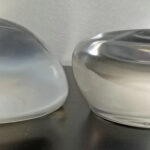
Smooth (left) and Textured (right) Silicone Implants

Smooth (left) and Textured (right) Saline Implants
More:
Print This Post
Posted on April 22, 2009 in Breast augmentation, Breast implants, Silicone implants
Breast implants are not permanent medical devices and should not be expected to last forever. They can be quite durable and long lasting but given enough time, all will eventually need to be replaced or removed. Many of my patients have the misconception that implants have to be replaced every 10 years whether they are silicone or saline. This is absolutely not true. The silicone implants manufactured today can last up to 20 to 30 years or more. Saline implants on average will have to be replaced sooner. Allergan’s (an implant manufacturer) ongoing prospective Core Study of silicone breast implants noted a rupture rate of 2.7% in 4 years for primary enlargements.
Many factors influence the durability of the implants. Some of these include:
- Type of implant – Saline versus Silicone. Silicone breast implants generally last longer and are more durable compared to saline implants. There are studies that show a 5 – 10 time greater rupture rates of saline implants as compared to silicone implants at various time periods.
- Textured versus smooth implants. In particular, textured saline implants have a noticeably shorter life span when compared to the smooth ones.
- Size of implant. Large implants may not last quite as long as small ones.
- Manufacturer of the implant. There are technological, manufacturing, and proprietary differences between the implant manufacturers that affect the lifespan of the implants. In over 20 years of practice, I have clearly found that significant “brand” differences.
- Surgical technique. A less gentle, more traumatic insertion of the implant can weaken the shell of the implant and predispose it to earlier failure and therefore a shorter lifespan. This can occur in silicone implants by trying to insert a large implant through a very small incision.
- Incision location. A trans-umbilical (belly button) incision can affect the durability of the implant due to the trauma of insertion. Insert large silicone implants through limited sized periareola or transaxillary (armpit) incisions can also be detrimental.
- Trauma. Very high energy impacts such as car accidents can potentially affect the long term durability. I have seen many women over the years who have been involved in serious car accidents without any injury to their implants. Sharp objects that are stuck in the breast can definitely rupture the implants
- Mammograms and frequency. Frequent mammograms, particularly aggressively compressing ones, can weaken the implant envelope.
Breast augmentation is a very rewarding procedure and is associated with an extremely high satisfaction rate. Like many other things in life, (almost) nothing lasts forever and this is true of breast implants as well.

Silicone implants - Smooth (Left) and Textured (Right)
To learn more about breast implants, breast augmentation or other cosmetic surgery, contact Dr. Turkeltaub at 480-451-3000.
Steven H. Turkeltaub, M.D.
Scottsdale and Phoenix Metropolitan Area, Arizona
More:
Print This Post
Posted on April 13, 2009 in Breast augmentation, Breast implants
Should I order that large entrée sized salad or still be hungry after eating the smaller appetizer salad? Will that 42” LCD TV look too small in the room or should I splurge and go for the 60” model. Do I want to live in a small apartment or a nice roomy house with a yard in a quiet neighborhood? Despite what you may have heard, size does matter.
With breast implants this is very true as well. When women come to see me in consultation, their first concern is about size. As is their second… They don’t request “I would like textured implants – in whatever size you have available.” or “Just give me something above the muscle.” No, it is size, size, and size. This is a variation on the mantra for a successful business where it is location, location, and location. Many studies show that the number one reason for reoperations in breast augmentation is unsatisfactory breast implant size. Nearly always it is because the size selected was not big enough.
Complicating this size issue is a misconception of what volume and proportion different cup sizes represent and what is truly proportionate or “fits my body”. One company’s “C” bra may fit exactly like another company’s “D” bra. Furthermore, many women think that a “B” is considered normal and proportionate whereas a “C” is too big. If I had proceeded to give them what they “wanted”, there would have been a lot of unhappy patients. We have had requests for a “small C”, a “regular C”, “large C”, a “small D”, etc. Have you ever gone to buy bras and asked the sales person to show you the selection of 34 large C bras? Or 36 small D bras? She would probably wonder what hole in the desert you crawled out from. There are no such bras! I’ve never seen them. Of course, then again, I have never personally bought a bra either!

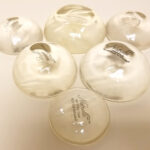
Different Breast Implant Sizes
Another issue aside from cup size and proportionality is that often women don’t really know what they want. Women want to be bigger but to what degree? What is too large or not large enough? What may be too big for one woman will be too small for another even though they voiced similar desires. I have found a few constructive ways to help my patients determine what they are really looking for. Trying on implants in the office, although not entirely accurate, gives my patients a 3 dimensional perspective that they can relate to. The photographs of a wide variety of previous breast augmentation patients with specific cup sizes are reviewed. Pictures from magazines or the internet can also be helpful but are limited by several issues including their two dimensional nature, clothing (on some), air brushing, resolution and perspectives. Some people on their own have used bags of rice stuffed into bras to help in sizing. Don’t try doing this with pasta – raw or cooked. It will not usually be a pleasant experience. I find that by carefully listening to my patients, seeing where they are coming from, their overall goals, etc., plus some intuition, I virtually always can determine the general appearance/size that would make them happy.
Based on all this input from my patients and their assessment, I make the final decision on the ideal implant size during surgery. If there is any doubt, it is always better to go a little bigger than a little smaller.
Yes, size does matter!
To learn more about breast implants, breast augmentation or other cosmetic surgery, contact Dr. Turkeltaub at 480-451-3000
Steven H. Turkeltaub, M.D.
Scottsdale, Arizona
More:
Print This Post
Posted on April 2, 2009 in Breast augmentation, Breast implants, Silicone implants
Silicone gel breast implants have been around since 1962. Over the ensuing years and with many design and technological changes, it has evolved into the safe, refined, durable and aesthetically pleasing implant that we have today. In the early days, there was a very high rate of capsular contracture, a situation where the body forms firm scar tissue around the implant causing palpable hardness and a deformed appearance of the breast. Changes were made in the 1970’s which helped lower this rate. However, with thinner implant shells and a less viscous form of silicone, there was a higher rate of implant rupture as well as silicone leaching through this outer envelope.
In the 1980’s and 1990’s, the implant shells were thickened, strengthened and made largely impermeable to the silicone. This has increased their durability and life span quite substantially. In addition, the silicone gel was altered to be far more viscous, into a cohesive form much like taffy or cream cheese. If one takes a knife and cuts a silicone implant in half (you can try this at home if you have an extra implant!), the halves maintain their fullness and shape. There is no oozing of any silicone because it is very sticky and cohesive.
In the early 1990’s, the news media began relentlessly generating unwarranted hysteria regarding the safety of these implants. Their misinformation created such a “feeding frenzy” that tens of thousands of anxious women across the country were calling their plastic surgeons concerned that they had a ticking time bomb inside them. Unfortunately, many went so far as to have their implants removed just on this fear alone despite no scientific evidence to justify their decision. Even today, I still get asked by many of patients considering silicone implants for breast augmentation: “Are they safe?”
Silicone implants are probably the most investigated, scrutinized of any medical device ever. Countless basic science and clinical studies to assess risks and other issues have been done over the years by a broad array of researchers including physicians, scientists, and manufacturers. In fact, the FDA restricted the usage of silicone implants between 1992 and 2006, until additional studies were performed to substantiate the safety of these implants. This data overwhelming supports the safety of silicone breast implants. It also shows that there is no causal relationship with significant diseases such as autoimmune diseases as had been contended by non-scientists. Quite importantly, there also is no increased incidence of breast cancer in women who have silicone implants.
When you are contemplating your breast augmentation, remember:”Yes, silicone implants are safe!”
To learn more about breast implants, breast augmentation or other cosmetic surgery, contact Dr. Turkeltaub at 480-451-3000
Steven H. Turkeltaub, M.D.
Scottsdale, Arizona
More:
Print This Post